Effective water management lies at the heart of a productive farm operation. An optimized irrigation schedule ensures that crops receive the right amount of water at the right time, boosting crop health and maximizing resource use. This guide walks through key steps for building a robust farm irrigation schedule, covering everything from initial assessment to ongoing adjustments.
Assessing Water Requirements
Before drafting any plan, understanding the unique water needs of your fields is crucial. Factors such as soil type, crop species, and local weather patterns determine how much water each zone requires.
Soil Analysis
- Test soil texture and structure to identify sand, silt, and clay proportions.
- Measure field capacity and wilting point to establish the water holding capacity.
- Analyze organic matter content: higher organic content improves moisture retention.
Crop Water Use
- Different crops exhibit varied evapotranspiration rates. Corn may use more water during tasseling than soybeans.
- Develop a lookup table of crop coefficients (Kc) to translate reference evapotranspiration (ET₀) into crop water needs.
- Account for growth stages: seedling, vegetative, flowering, and fruiting each demand different volumes.
Climate Considerations
- Collect historical climate data: rainfall patterns, temperature highs and lows, humidity trends.
- Factor in seasonal variability and extreme events like heatwaves or droughts.
- Monitor real‐time weather forecasts for irrigation timing adjustments.
Designing the Irrigation Schedule
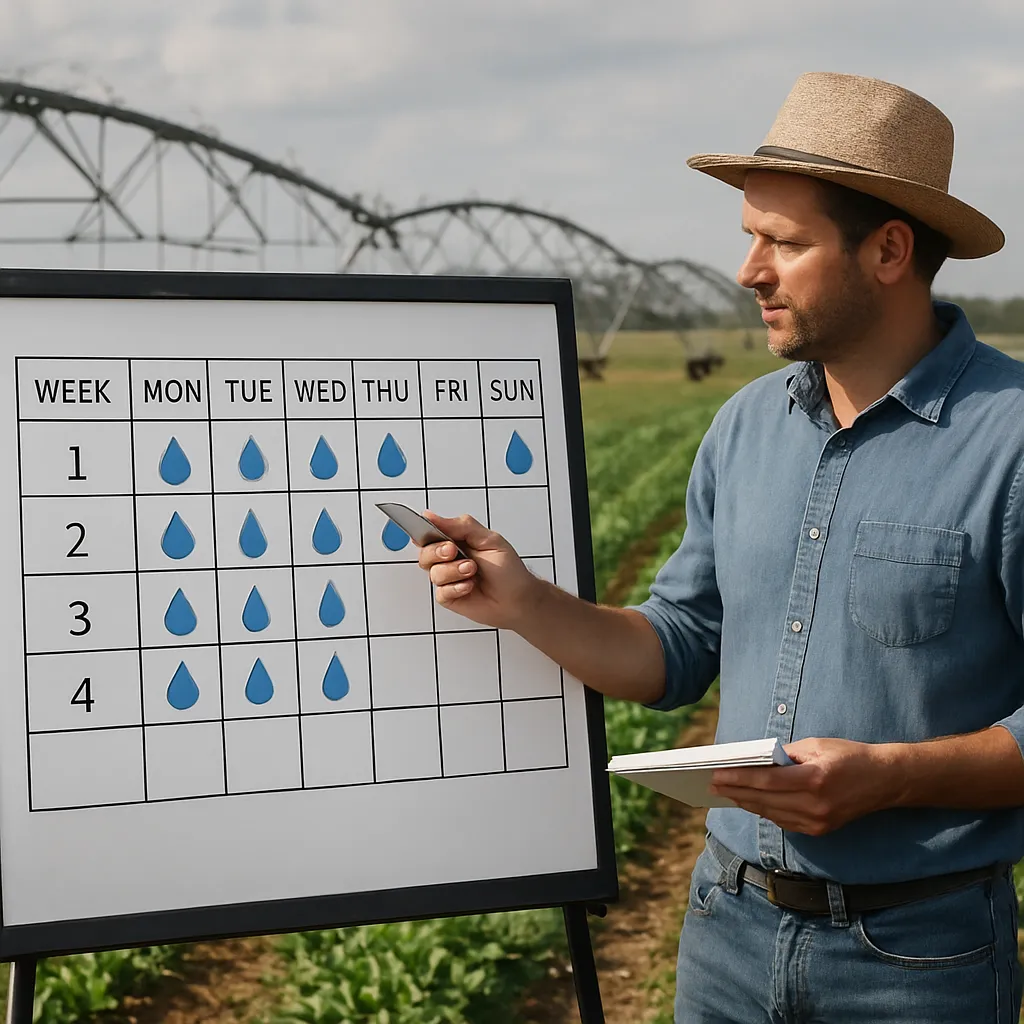
With water demand quantified, the next step is creating a practical timetable. The goal is to ensure uniform distribution while avoiding over‐ or under-watering.
Selecting Irrigation Methods
- Surface irrigation: simple but can have low distribution uniformity and higher evaporation.
- Sprinkler systems: versatile and capable of covering irregular fields; efficiency varies by nozzle type.
- Drip irrigation: high efficiency, minimal evaporation loss, and precise delivery to root zones.
Calculating Run Times
Determine how long to run each irrigation zone using this formula:
Total water needed per cycle (inches) ÷ Application rate (inches/hour) = Run time (hours)
- Adjust run times per zone based on soil water holding capacity and slope.
- Include buffer time to account for system start-up and shut-off transients.
Scheduling Frequency
- Frequent, shorter cycles help maintain consistent soil moisture and reduce runoff.
- Longer intervals between irrigations allow for deeper root growth, improving drought resistance.
- Balance frequency and depth: know the refill depth for each field and avoid leaching nutrients.
Implementing and Monitoring the Plan
Putting the schedule into action and tracking performance ensures the system operates as intended. Automation and data collection tools can greatly enhance efficiency.
Automation and Control
- Install programmable controllers or smart valves to automate start and stop times.
- Integrate soil moisture sensors to trigger irrigation when moisture falls below set thresholds.
- Leverage remote monitoring platforms for real-time alerts on leaks, pressure drops, or power failures.
Field Measurements
- Deploy tensiometers or capacitance probes at multiple depths to track soil water tension.
- Use handheld flow meters to verify actual application rates against design values.
- Conduct periodic catch-can tests under sprinklers to assess distribution uniformity across the field.
Data Management
- Create logs of irrigation events, weather conditions, and soil sensor readings.
- Analyze trends to identify over-irrigated or under-irrigated zones.
- Produce visual maps of irrigation performance to guide future adjustments.
Adjusting the Schedule Over Time
Irrigation scheduling is not a set-and-forget task. Changes in weather, crop stage, or system wear demand regular recalibration to maintain efficiency.
Seasonal Updates
- Early season: start with conservative volumes to avoid waterlogging young roots.
- Peak season: increase run times during high heat and low humidity periods.
- Late season: taper off irrigation to prepare crops for harvest and reduce disease risk.
System Maintenance
- Clean filters, flush drip lines, and inspect nozzles every few weeks to prevent clogging.
- Check pressure regulators and replace worn seals to avoid leaks and pressure fluctuations.
- Service pumps and motors regularly to ensure reliable water delivery.
Continuous Improvement
- Compare actual yields against planned targets to gauge irrigation effectiveness on crop performance.
- Incorporate new research on water-saving technologies and emerging automation tools.
- Engage with extension services or agronomists for expert recommendations tailored to your farm.